
Reaching for a standard can of oil-based lubricant might be the most common mistake homeowners make when a door starts sticking. While it feels like a quick fix, using the wrong product often attracts grit that leads to a seized mechanism. Learning how to lubricate a upvc door lock correctly is about more than just convenience; it’s about protecting your home’s security and your family’s peace of mind. We understand that “crunchy” feeling in the handle can be stressful, especially when you’re worried about the cost of an emergency locksmith or the fear of a key snapping in the cylinder.
We believe every homeowner deserves a door that operates with dignity and ease. You shouldn’t have to struggle with a heavy handle or a stubborn key just to enter your own sanctuary. This 2026 guide provides the professional techniques you need to restore that smooth operation using modern dry lubricants. We’ll walk you through the two-part process of treating the lock’s “brain” with dry powder and its “limbs” with PTFE spray, ensuring your multipoint system remains functional and secure for years to come.
Key Takeaways
- Identify the specific dry lubricants, such as PTFE or silicone-based sprays, that protect your mechanism without attracting damaging grit.
- Distinguish between the euro cylinder and the multipoint locking strip to apply targeted care to each component’s unique needs.
- Master the professional step-by-step method for how to lubricate a upvc door lock to ensure smooth handle operation and prevent the key from snapping.
- Recognize the subtle differences between a dry lock and a failing gearbox so you can address mechanical issues before they become emergencies.
- Establish a consistent maintenance rhythm that preserves your home’s security and provides lasting peace of mind for your family.
Understanding Why Your UPVC Door Lock Becomes Stiff or Sticky
Your front door is more than just an entrance; it’s the primary guardian of your family’s safety and sanctuary. When that handle starts to feel heavy or the key resists your touch, it’s easy to feel a sense of frustration or even anxiety. Most UPVC doors rely on a complex multipoint locking system that runs the full height of the door. This mechanism ensures your home stays sealed and secure, but its intricate nature means that even a small amount of friction can disrupt the entire operation. Learning how to lubricate a upvc door lock correctly starts with recognizing that these moving parts are constantly battling the elements to keep you safe.
Inside the door, the gearbox acts as the heart of the system. Over time, microscopic metal shavings from natural wear, combined with household dust and outdoor grit, settle into the internal tracks. This creates a gritty paste that acts like sandpaper against the delicate Pin tumbler lock mechanism. We often see homeowners trying to force a stiff handle, which puts immense pressure on the internal cam. If this cam snaps, the door may become permanently locked in either the open or closed position. This leads to a much more stressful situation than a simple afternoon of maintenance.
Common Signs Your Lock Needs Immediate Attention
You might notice that lifting the handle feels like a workout rather than a smooth, fluid motion. This usually indicates that the rollers or hooks are struggling to engage with the keeps on the frame. If the key feels spongy or bounces back when you try to complete the final turn, the cylinder is likely clogged with debris. Listen for any audible grinding or clicking. These sounds are the mechanism’s way of telling you that internal grit is obstructing its path and causing premature wear.
Environmental Factors in the North West
Moisture ingress is a silent enemy for untreated locks in Liverpool. Rainwater can seep behind the faceplate, causing the internal lubricants to wash away or become contaminated. Seasonal expansion also plays a massive role. During the damp winter months or the occasional hot summer spell, the UPVC material can expand or contract. This movement mimics a lock failure by misaligning the bolts. Often, a thorough cleaning and proper lubrication can resolve this tension before permanent damage occurs to the gearbox.
The Best Lubricant for UPVC Door Locks (And Why WD-40 is a Risk)
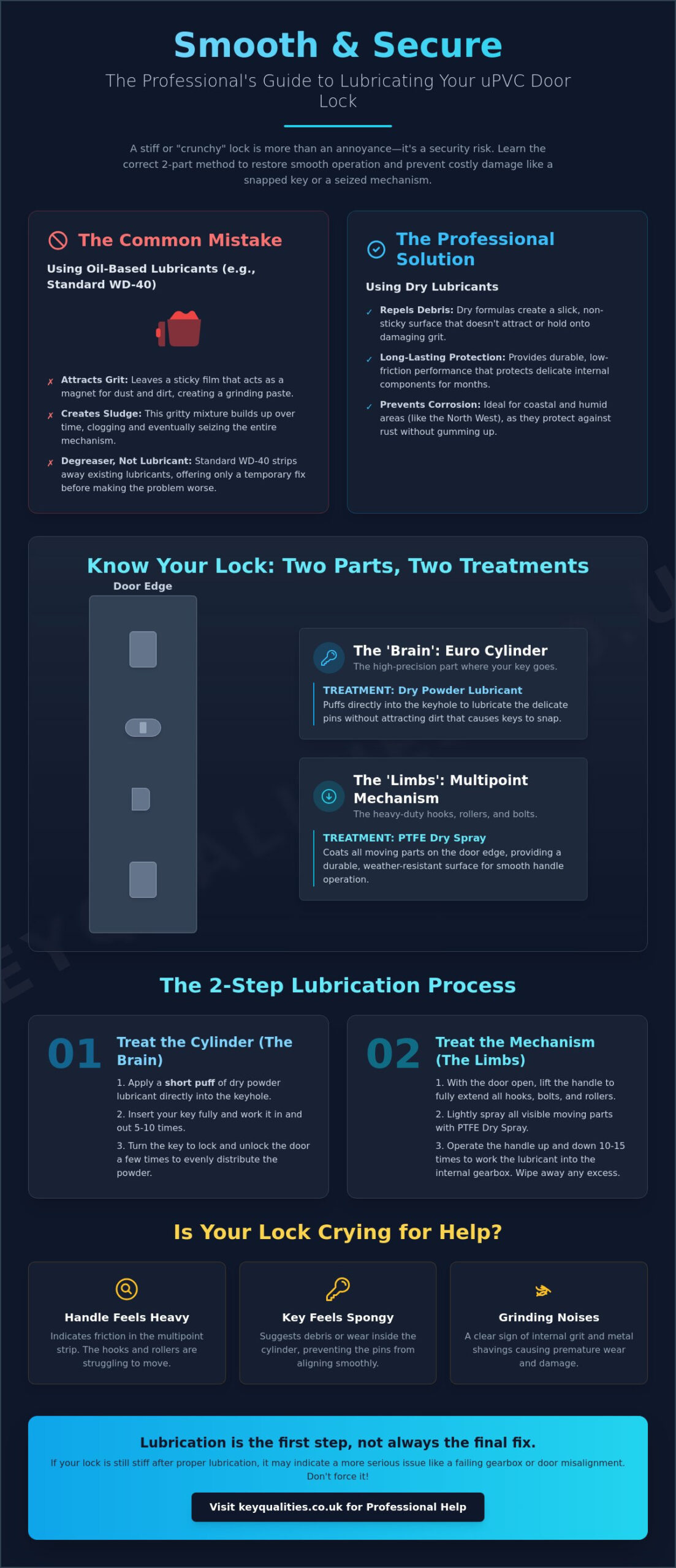
Choosing the wrong product for your door can transform a minor stiffness into a major mechanical failure. We often see homeowners reach for standard WD-40 because it’s a household staple, but in the professional security sector, this is known as the “WD-40 Trap.” While standard WD-40 is excellent at freeing rusted bolts, it’s actually a degreaser and penetrant rather than a long-term lubricant. It leaves behind a thin, sticky film that acts like a magnet for the Liverpool grit and dust we mentioned earlier. Over time, this mixture creates a thick sludge that can eventually seize the entire multipoint system, making it nearly impossible to turn the key.
As highlighted by the Master Locksmith’s Association, the type of lubricant you use directly impacts the longevity of your security hardware. For a UPVC door to remain a reliable barrier for your family, you need a “non-gumming” formula. These products are engineered to provide a low-friction surface without creating the buildup that leads to expensive repairs. While silicone-based sprays are often marketed as a middle ground, they can still remain too “wet” for the high-precision tolerances of a modern lock. If you’re concerned about the current state of your hardware, a professional home security assessment can help identify if your locks are already suffering from improper maintenance or internal wear.
Understanding the chemical difference between dry and wet lubricants is essential for any homeowner. Wet lubricants, like oils or greases, are designed for heavy machinery where the parts are sealed away. In contrast, the exposed nature of a door lock requires a dry lubricant that evaporates quickly, leaving only a protective, slippery layer behind. This ensures that the delicate internal springs can move freely without being weighed down by oily residue. Learning how to lubricate a upvc door lock effectively means matching the right chemical solution to the specific part of the lock you are treating.
PTFE (Teflon) Sprays: The Professional Choice
PTFE sprays are the gold standard for maintaining the long multipoint strips that run down the side of your door. These sprays create a microscopic, low-friction film that allows hooks and rollers to glide into place with minimal effort. They also possess excellent water-displacing properties, which is vital for protecting external doors against the damp North West climate. PTFE spray serves as the primary solution for lubricating the multipoint strip and all external moving parts of the door mechanism.
Graphite Powder: The Cylinder Specialist
The internal cylinder is a sensitive environment where liquid lubricants should never be used. Even the best sprays can cause the tiny pins and springs inside a cylinder to stick together over time. Graphite powder is a dry, mineral-based lubricant that interacts perfectly with these components to ensure a smooth turn every time. You should apply it sparingly by puffing a small amount into the keyhole. Be aware that graphite can be messy; always keep a damp cloth nearby to wipe away any black dust that might settle on your door finish or handles.
Locating the Key Points: Cylinder vs. Multipoint Mechanisms
Your door is a complex system designed to offer both convenience and a robust defense for your home. To truly understand how to lubricate a upvc door lock, you must first be able to identify the different components that make up the whole. We view the smooth, effortless operation of your door as a benchmark for the overall quality of your home’s security. A typical UPVC door consists of two distinct but interconnected systems: the euro cylinder and the multipoint locking strip. Providing professional support to maintain these mechanisms is our way of improving the lives of the families we serve by ensuring their sanctuary remains accessible and safe.
The gearbox serves as the hidden heart of your door security. It lives inside the door sash, directly behind your handles, acting as the central hub that coordinates every movement. While the gearbox itself is mostly enclosed, manufacturers often include small lubrication holes along the metal faceplate on the door’s edge. These entry points allow you to reach the internal gears without needing to dismantle the entire door. Look for small circular or oval cutouts, sometimes marked with a tiny icon or an arrow, which indicate where the mechanism requires a professional touch. Treating these ports correctly prevents the internal components from grinding against each other.
The Euro Cylinder: The Brain of the Lock
We often refer to the euro cylinder as the “brain” because it’s the part that verifies your key before allowing any movement. You can locate the keyway easily on either side of the door. This is where the internal plug rotates when the correct key is inserted. Because the tolerances inside are so tight, this component requires a much more delicate maintenance approach than the rest of the door. For more details on identifying your specific hardware, you can consult the ultimate guide to door locks to ensure you’re using the right techniques for your home’s unique setup.
The Multipoint Strip: The Moving Parts
The multipoint strip represents the “limbs” of your door. This long metal band runs vertically along the edge of the door and houses various locking points. Depending on your door’s age and brand, you might see hook bolts that pull the door into the frame, deadbolts for central security, or rollers that help with weather sealing. Each of these moving parts creates a friction point where the metal meets the “keep” on the door frame. When you lift the handle, you are engaging the entire length of this strip. Don’t forget the spring-loaded latch, which is the small triangular bolt that clicks into place every time you close the door without locking it. This latch undergoes the most frequent use and often shows the first signs of friction or resistance.
Step-by-Step Guide: How to Safely Lubricate Your UPVC Door Lock
Taking the time to maintain your home’s entry points is a meaningful act of stewardship. It ensures that your sanctuary remains a place of ease rather than a source of daily frustration. Before you begin, gather a clean microfiber cloth, a can of PTFE dry lubricant with a straw applicator, and a small tube of graphite powder. We recommend placing a piece of cardboard or a drop cloth beneath the door to protect your flooring from any stray particles. This simple preparation reflects a high standard of care for your property and your living environment.
The first and most vital step is cleaning. Many guides overlook this, but applying new lubricant over old grit only creates a thicker abrasive paste. Open the door fully and use your cloth to wipe down the entire length of the metal multipoint strip. Pay close attention to the areas around the hooks, rollers, and the latch. Once the surface is clear of visible debris, you are ready to learn the professional method for how to lubricate a upvc door lock effectively. This process restores the dignity of a functional home and prevents the anxiety of a potential lockout.
- Step 1: Clean the Mechanism. Use a dry cloth to remove dust and old grease from the locking strip and the keeps on the frame.
- Step 2: Apply PTFE Spray. Use the straw applicator to direct short bursts of PTFE spray into the moving parts of the multipoint hardware, including the hooks, bolts, and rollers.
- Step 3: Treat the Cylinder. Puff a small amount of graphite powder into the keyway. Avoid using any liquid sprays here to prevent the internal pins from gumming up over time.
- Step 4: The Cycle Technique. Insert your key and turn it several times, then lift and lower the handle repeatedly. This movement distributes the lubricant deep into the internal gears and tracks.
The Proper Application Technique
In the world of professional maintenance, less is almost always more. You don’t need to drench the mechanism. Instead, focus on precision. Use the straw to reach the internal springs behind the latch and inside the lubrication holes marked by the manufacturer. When treating the cylinder, coat your key with a little graphite powder and slide it in and out of the lock. This helps the lubricant reach the deepest pins without creating an unsightly mess on your door finish.
Post-Lubrication Testing
Always test the operation with the door open first. The handle should feel light, and the key should turn without any resistance. If the mechanism feels smooth while open but becomes difficult once closed, you likely have a misalignment issue rather than a lubrication problem. If your efforts don’t restore that effortless feel, it may be time to consult our experts on UPVC door repairs in Liverpool to prevent a total mechanical failure. For immediate peace of mind, you can book a professional multipoint locking system repair to ensure your home remains fully secure and functional.
When Lubrication Isn’t Enough: Identifying Gearbox and Alignment Issues
While mastering how to lubricate a upvc door lock is a vital skill for any homeowner, there are times when maintenance simply cannot overcome mechanical failure. We understand the sinking feeling when, despite your best efforts with a cleaning cloth and PTFE spray, the handle remains stubbornly heavy. In many cases, the issue isn’t a lack of lubrication, but a physical shift in the door’s structure known as the “dropped door” phenomenon. Because UPVC doors are heavy, the constant pull of gravity can cause the hinges to settle over time, moving the locking points out of alignment with the keeps on the frame.
A failed gearbox often mimics the symptoms of a dry lock, but the internal reality is much more serious. If you experience a “crunching” sensation or hear clicking sounds when you lift the handle, it often indicates that the internal metal teeth have stripped or shattered. We see many situations where a homeowner tries to force the handle to engage the bolts, which can lead to snapping the internal spindle or the handle itself. This turning of a minor alignment issue into a total mechanical break is exactly what we want to help you avoid. Professional intervention at this stage is an act of empowerment; it allows for a precise UPVC door gearbox replacement or a multipoint locking system repair before you find yourself unable to secure your home.
The Paper Test for Door Alignment
You can perform a simple check to see if your door hinges have dropped. Place a piece of paper between the door and the frame, then close the door. Try to slide the paper along the edge. If the paper is trapped tightly at the top but falls out at the bottom, your door is physically out of square. Lubrication cannot fix a door that is no longer straight. Key Qualities assesses door geometry before recommending a repair to ensure we are addressing the structural root cause rather than just the surface symptoms.
When to Call Key Qualities
If your lock continues to resist after a thorough cleaning, it’s time to seek a partner who understands the high stakes of home security. A professional home security assessment can provide the clarity you need to keep your sanctuary safe. We bring 40 years of experience to every interaction, which is particularly essential when dealing with obsolete UPVC parts that require specialized knowledge to source and fit. We don’t just provide workers; we provide dedicated advocates who share your values and want to ensure your home remains a functional, dignified space for your family.
Securing Your Home for the Years Ahead
If your lock continues to feel heavy or makes grinding noises, it may indicate a structural alignment issue that maintenance alone cannot fix. Struggling with a stubborn lock? Let Key Qualities restore your security with expert UPVC repairs today. We are a family-run Liverpool business with over 40 years of experience in construction and locksmith services. Our team specializes in non-destructive entry and UPVC gearbox replacement, bringing a human-centric approach to every repair. We are here to act as your dedicated advocate for a safer, more functional home.
Frequently Asked Questions
Can I use WD-40 to lubricate my UPVC door lock?
No, you shouldn’t use standard WD-40 on your UPVC mechanisms because it’s a degreaser that leaves a sticky film behind. This residue attracts dust and Liverpool salt-air grit, which eventually forms a thick paste that can seize the gearbox. Instead, choose a specialist dry PTFE spray for the hardware and graphite for the cylinder to ensure your home remains accessible and secure.
How often should I lubricate my door locks in Liverpool?
We recommend performing this maintenance at least once every twelve months to keep your home’s entry points functioning smoothly. However, for homes in coastal Liverpool neighbourhoods, the high salt content in the air can accelerate corrosion. In these areas, lubricating every six months provides a higher standard of protection for your multipoint system and prevents the anxiety of a sudden mechanical failure.
Why is my UPVC door handle so hard to lift?
A heavy handle is usually a sign of excessive friction within the multipoint locking strip or a physical misalignment of the door. When the rollers and hooks can’t glide into their keeps, you have to apply more force, which risks snapping the internal gearbox. Proper knowledge of how to lubricate a upvc door lock can often solve this, but persistent resistance may require a professional hinge adjustment.
What is the best dry lubricant for a euro cylinder lock?
Graphite powder is the superior choice for euro cylinders because it provides excellent lubrication without any oily residue. Unlike liquid sprays, it won’t cause the delicate internal pins and springs to stick together over time. Applying a small amount ensures a smooth key turn, which is a benchmark of a well-maintained and reliable security system for your family.
Can a stiff lock be a sign of a burglary attempt?
Yes, a lock that suddenly becomes stiff or difficult to operate can occasionally be a sign of a failed lock snapping attempt. If you notice fresh scratches around the keyhole or the cylinder feels loose, it’s vital to act with urgency. We recommend a professional home security assessment to ensure your door still meets British Standards and provides the protection your household needs.
Will lubricating my lock fix a door that has dropped?
No, lubrication cannot correct the physical geometry of a door that has moved out of its square frame. While learning how to lubricate a upvc door lock is essential for part maintenance, it won’t help if the bolts are hitting the frame instead of the holes. If the handle is only hard to lift when the door is closed, you likely need a professional hinge adjustment rather than more spray.
Is it better to use graphite powder or PTFE spray?
You actually need both products to maintain a high-standard operational partner for your home’s security. Graphite powder is the specialist for the internal key cylinder, while PTFE spray is designed for the long metal locking strip and moving bolts. Using them in their correct locations ensures that every part of your door functions with the dignity and ease you expect.
What happens if I use oil-based lubricants in my lock?
Oil-based lubricants will eventually cause your lock to fail by attracting debris that clogs the high-precision internal components. Over time, this buildup creates a gumming effect that puts immense strain on the gearbox and internal springs. This can lead to a snapped key or a jammed door, necessitating emergency lockout assistance that could have been avoided with the right dry lubricant.