
Last October, a homeowner in Woolton discovered that a standard uPVC handle offers almost no resistance against a “lock snapping” attack, a method used in 25% of Merseyside burglaries according to local crime reports. It’s a sobering thought that an inadequate door lock can turn your sanctuary into a vulnerability in under 15 seconds. You deserve to feel safe in your own space, yet the confusing terminology of the security industry often makes it difficult to know if you’re truly protected. We believe that quality security is a fundamental part of your well-being, as empowering your safety is the first step toward enriching your life.
You likely agree that securing your property shouldn’t require a degree in engineering, even if the technical jargon feels complex. Our mission is to provide you with a clear, expert breakdown of the best protection for Liverpool properties in 2026. This guide explains insurance compliance, the vital TS007 3-star standards, and how to choose hardware that ensures your home remains a reliable haven for your family.
Key Takeaways
- Learn how to tailor your security to your specific Liverpool property, ensuring your home remains a safe sanctuary for your family and loved ones.
- Understand the critical differences between Mortice Deadlocks and Euro Cylinders to ensure you select the correct door lock for your home’s specific material and design.
- Discover why BS3621 standards and anti-snap technology are essential for maintaining valid home insurance and protecting against common local security risks.
- Recognise the early warning signs of lock failure, such as “sticky” keys or misalignment caused by the North West’s damp climate, before they lead to an emergency.
- Benefit from our 40-year heritage in Merseyside as we guide you through a purposeful approach to securing your property and your peace of mind.
Understanding the Foundations: Why Your Door Lock Matters in Liverpool
Your door lock represents the primary mechanical barrier between your family and the outside world. It is the first line of defence in a comprehensive security strategy, acting as a physical deterrent that safeguards your sanctuary. In Liverpool, the architectural landscape is incredibly diverse. You might reside in a 19th-century Georgian townhouse in the Canning Street area or a sleek, 2026-spec apartment in the Baltic Triangle. Each of these environments presents unique vulnerabilities. A security solution that works for a heavy oak door in Woolton will not necessarily provide the same level of integrity for a modern composite frame in a city centre development.
Choosing the right hardware is about more than just preventing unauthorised access. It is about the psychological transition from a state of constant anxiety to one of empowerment. When you trust your home is secure, your focus shifts toward well-being and community connection. Understanding the technical side is vital. A basic latch provides convenience for day-to-day movement, but it lacks the structural strength required for external protection. For true security, you must implement a high-security deadlock. This mechanism ensures that the bolt cannot be retracted without a key, providing a robust defence against intruders. You can explore a variety of types of door lock to see how these mechanisms differ in their internal engineering and resistance levels.
Matching Locks to Liverpool Property Types
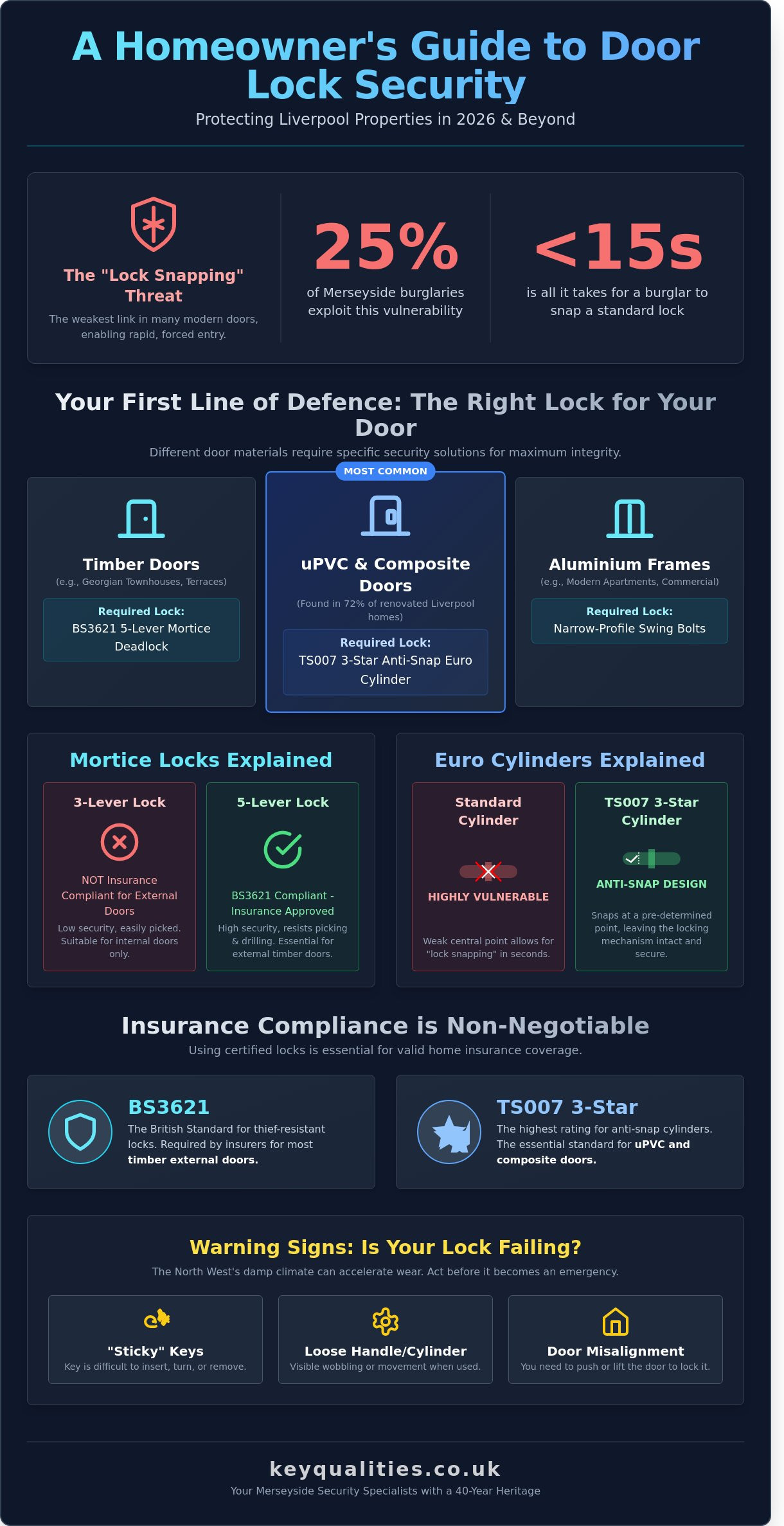
The traditional timber doors found in older Merseyside terraces require specific care. These doors typically rely on mortice locks, which are fitted into a pocket cut into the edge of the door. For modern UPVC and composite doors, which are now found in 72% of renovated Liverpool homes, the multi-point locking system is the standard. This system secures the door at several points along the frame with a single turn of the key. You must identify your door material before choosing hardware to ensure the door lock integrates seamlessly with the frame’s structural integrity.
- Timber Doors: Require BS3621 compliant five-lever mortice deadlocks.
- UPVC/Composite Doors: Benefit from anti-snap cylinders and multi-point hooks.
- Aluminium Frames: Often found in modern apartments, requiring narrow-profile swing bolts.
The Cost of Compromise: Standard vs High-Security
Opting for “cheap” or unbranded hardware often leads to expensive emergency call-outs. Low-quality components fail under stress, frequently jamming and leaving residents stranded. Security grade is the measure of a lock’s resistance to forced entry. Investing in high-grade hardware reduces long-term property maintenance costs because quality materials withstand the corrosive effects of the salty Mersey air. By choosing excellence over convenience, you ensure your home remains a place of dignity and safety for everyone inside.
The Core Types of Door Lock Explained
Securing your home is about more than just installing hardware; it is about ensuring the safety and well-being of everyone inside. Selecting the right door lock creates a foundation of trust and peace of mind for Liverpool families. Understanding the mechanical differences between these systems allows you to make an informed choice that protects your property and meets modern safety standards.
Mortice Locks: 3-Lever vs 5-Lever
Mortice locks are embedded directly into the fabric of wooden doors, providing a flush, high-strength finish. For external entrances, a 5-lever mortice deadlock is the essential standard. Most UK insurance providers require these locks to meet BS3621 specifications to ensure valid coverage. The additional levers increase the complexity of the internal mechanism, which significantly improves resistance against picking and drilling. If you require a handle to operate the door during the day, a sashlock is the ideal choice. For purely secondary security where no handle is needed, a deadlock provides a robust, key-only solution.
Euro Cylinders and the UPVC Revolution
The Euro cylinder is the central “barrel” found in almost every modern UPVC and composite door in Liverpool. While these locks offer incredible convenience, standard cylinders are often the weakest link due to a vulnerability known as “lock snapping.” To achieve a high standard of protection in 2026, homeowners should insist on TS007 3-star rated cylinders. These are designed to snap in a controlled way that keeps the internal mechanism locked. Getting a secure fit is vital. You must measure from the centre of the fixing screw to both the internal and external edges of the door. A cylinder that protrudes more than 3mm from the handle is a target for intruders.
Rim Latches and Secondary Security
Commonly referred to as “Yale locks,” rim latches sit on the inside surface of the door. They offer excellent “auto-locking” convenience, which is helpful for busy households where a door might accidentally be left ajar. However, a latch alone is rarely enough for a front door. We recommend pairing a high-quality rim latch with a 5-lever deadlock to create a dual layer of protection. It’s also important to select durable door handles that complement your latch and provide a comfortable grip for all residents, including those with limited mobility. For internal doors where security isn’t the primary concern, understanding the best door latch options for Liverpool homes ensures smooth operation and proper fit for your specific property type.
Multi-point Locking Systems
Multi-point systems are the standard for modern security, engaging at least three points along the door frame simultaneously. When you lift the handle and turn the key, bolts or “hooks” lock into the top, middle, and bottom of the frame. This distribution of pressure makes it nearly impossible to force the door open from a single point of impact. Ensuring these systems are professionally aligned is a simple way of improving home safety and extending the life of your door hardware.
- BS3621: The British Standard for thief-resistant locks.
- Snap-Resistant: A vital feature for any Euro cylinder lock.
- Sashlock: A mortice lock containing both a bolt and a latch for handle use.
Insurance Standards and the Anti-Snap Essential
Your home is more than just a building; it’s a sanctuary that deserves the highest level of protection. Choosing the right door lock isn’t just a matter of convenience, it’s a vital step in safeguarding your family and ensuring your insurance policy remains a reliable safety net. In Liverpool, where community safety is a shared priority, understanding the technical benchmarks of security empowers you to make decisions that truly enrich your home life.
Decoding British Standard BS3621
The BS3621 standard is the hallmark of domestic security in the UK. You can identify this by looking for the BSI Kitemark engraved on the faceplate of the lock, which looks like a heart with an “S” in the centre. Insurance providers generally mandate this standard for all external entry points. If a door lock fails to meet these requirements, a claim following a break-in may be declined, leaving you vulnerable during an already stressful time. A high-quality British Standard lock upgrade ensures your home meets these rigorous safety benchmarks:
- A minimum of five levers or a cylinder that resists drilling and picking.
- A deadbolt that extends at least 20mm into the frame when locked.
- Hardened steel plates to protect the internal mechanism from physical attack.
- A box striking plate that reinforces the door frame.
The 3-Star Solution: Anti-Snap Technology
Lock snapping is a method used by intruders to gain entry in under 15 seconds by applying force to the cylinder. This technique has become a specific concern across the North West, making standard Euro cylinders a significant liability. We believe in proactive protection, which is why anti-snap lock installation in Liverpool is now considered an essential preventative measure for modern homes. These locks feature a sacrificial cut line; if an intruder attempts to snap the lock, only the front section breaks away, leaving the central locking mechanism intact and the door secure.
When selecting a cylinder, look for the star rating system. A 1-star cylinder provides basic protection but should be paired with a 2-star security handle. For the ultimate peace of mind, a 3-star Kitemark cylinder or the SS312 Diamond Standard provides the highest level of resistance currently available. Professional installation is the final piece of the puzzle. A correctly fitted lock ensures that the cylinder doesn’t protrude more than 3mm from the handle, which is a critical factor in preventing the grip required for snapping. By investing in these standards, you aren’t just buying hardware; you’re investing in the long-term well-being of your household.
Signs Your Door Lock Needs Professional Attention
Your home should be a place where you feel completely safe and supported. A failing door lock is more than a minor annoyance; it’s a vulnerability that affects your family’s well-being and peace of mind. Recognising the early warning signs of wear allows you to take proactive steps before a total mechanical failure leaves you stranded outside or, worse, compromises your home’s integrity.
Mechanical Warning Signs
- Grinding and Resistance: If you hear a crunching sound or feel resistance when turning the key, the internal pins are likely worn or clogged with debris.
- The 360-Degree Spin: When a key turns all the way round without engaging the bolt, the actuator or cam has failed. This means your door isn’t actually locked, even if the key feels like it’s working.
- Handle Sag: A “floppy” handle that doesn’t spring back to a horizontal position indicates a broken spring or a failing internal gearbox.
You should never force a multipoint locking system if it feels jammed. These systems are intricate. Applying excessive pressure can snap the drive gear. This turns a simple alignment fix into an expensive replacement of the entire locking strip.
Maintenance Tips for Liverpool Homeowners
Liverpool sees an average of 190 rainy days per year. This high humidity creates a challenging environment for hardware. Moisture causes wooden doors to swell and metal components to corrode. We often see UPVC doors that have dropped by as little as 2mm, which is enough to misalign the locking points and put immense strain on the door lock mechanism.
To maintain your security, avoid using WD-40 inside the cylinder. While it provides a temporary fix, it’s a solvent that attracts dust and grit, eventually creating a thick paste that jams the pins. Instead, use a dedicated graphite powder or a silicone-based lubricant every six months to keep the movement fluid. During seasonal shifts, check that your door latches easily without you having to lift or pull the handle with force. If the door requires a “knack” to lock, it’s time to call for a professional review.
Security isn’t only about mechanical failure. Data from the Office for National Statistics shows that roughly 5% of UK households move home each year. If you’ve recently moved into a new property in Merseyside, changing the locks is an essential step. You can’t account for every spare key held by previous tenants, builders, or estate agents. Upgrading your locks ensures you have total control over who enters your sanctuary.
Protect your home with a partner who cares about your safety. Contact KeyQualities today for a comprehensive security assessment and professional lock upgrade.
Key Qualities: Professional Lock Installation in Liverpool
Since 1986, our team has maintained properties across Merseyside with a steadfast commitment to integrity and excellence. We don’t just fit a door lock; we secure your peace of mind through a dedicated “Purpose-Result” approach. This philosophy ensures that every piece of hardware we install serves the direct goal of protecting your family’s well-being. Our 40-year heritage in the region means we understand the specific security challenges faced by residents from Crosby to Childwall.
Local expertise is vital for a rapid response. We aim to reach most Liverpool postcodes within 60 minutes when urgent security needs arise. Our locksmiths possess deep knowledge of the diverse housing stock in the city, from traditional Victorian terraces to modern city-centre apartments. This experience allows us to select the correct hardware for your specific door type on the first visit. We invite all Liverpool residents to contact us for a free home security assessment to ensure your property remains a safe haven.
Expert Installation vs DIY Risks
Attempting a DIY installation often leads to technical errors that compromise your home’s perimeter. A cylinder that protrudes more than 3mm from the handle or a misaligned strike plate can make a door lock vulnerable to snapping or bypass techniques. These small mistakes often invalidate home insurance policies, as 95% of UK insurers require locks to be fitted according to BS3621 standards. Our vetted professionals guarantee that every installation meets these strict criteria. We prioritise non-destructive entry and clean workmanship, ensuring your door remains structurally sound and aesthetically pleasing.
Your Next Steps to a Safer Home
Securing your property shouldn’t be a complex or stressful process. You can book a Liverpool locksmith for a same-day upgrade to ensure your home is protected by tonight. We focus on mechanical excellence, recommending high-security manual cylinders over complex electronic systems that may suffer from battery failure or software vulnerabilities. Our mission is to empower homeowners by providing bespoke solutions that reflect our values of compassion and reliability. You deserve a partner who understands the high stakes of home security and acts with a sense of urgency. Secure your Liverpool home today with Key Qualities to experience the stability that comes from professional protection.
Protecting Your Home and Your Peace of Mind
Choosing a high-standard door lock isn’t just a technical necessity; it’s a commitment to the safety and well-being of your household. Ensuring your property meets British Standard BS3621 helps you stay compliant with insurance requirements while providing the robust protection your home deserves. We’ve seen how anti-snap technology prevents common forced entry methods, making it an essential upgrade for any modern Liverpool residence in 2026.
Our team brings over 40 years of local industry experience to every call, acting as a bridge between your security needs and professional excellence. We specialise in British Standard BS3621 upgrades and expert UPVC repairs, ensuring every bespoke solution we provide upholds the security of your property. By focusing on quality and integrity, we help create a secure environment where your family can feel truly safe. We believe that professional security is a fundamental part of empowering care and enriching lives within our community.
Book your high-security lock upgrade with Key Qualities today
Your safety is our priority, and we’re ready to help you secure your home today.
Frequently Asked Questions
What is the most secure type of door lock for a front door?
The most secure door lock for a timber front door is a 5-lever mortice deadlock that meets the BS3621 standard. For those with UPVC or composite doors, a 3-star TS007 cylinder provides the highest level of protection against modern entry methods. These high-quality components ensure your home remains a sanctuary of safety, providing the integrity needed to protect your family’s well-being.
Does my home insurance require a specific type of door lock?
Yes, 95% of UK home insurance providers require your external door lock to be British Standard BS3621 compliant. Failure to use these vetted security measures can void your policy during a claim. We believe in proactive protection to ensure you’re never left vulnerable. Check your policy documents today to confirm your specific coverage requirements and maintain your peace of mind.
What is an anti-snap lock and do I really need one in Liverpool?
An anti-snap lock is a cylinder designed to resist snapping, a method used in 25% of Merseyside burglaries according to recent police data. You definitely need one in Liverpool to ensure your property’s integrity. These locks feature a sacrificial cut that keeps the internal mechanism secure even if the front is broken off. It’s a simple upgrade that empowers your home security.
Can I change a door lock myself or should I hire a locksmith?
You can change a lock yourself, but hiring a professional locksmith ensures the installation meets high-quality safety standards. Incorrect DIY fitting often voids manufacturer warranties and insurance policies. Our commitment to excellence means we always suggest professional fitting. This creates a bridge between basic housing and a truly secure, empowered home environment for your loved ones.
How much does it cost to have a new door lock fitted in Liverpool?
According to 2024 industry data from Checkatrade, the average cost to have a new lock fitted in Liverpool ranges from £65 to £90 for labour, plus the price of parts. Prices for high-quality cylinders typically start around £35. Investing in professional installation ensures your security is never compromised. It’s a small price to pay for the long-term stability and safety of your community.
What should I do if my UPVC door lock is sticking?
If your UPVC door lock is sticking, it’s usually caused by door misalignment or a failing gearbox. Don’t force the handle, as this often breaks the internal mechanism. Try using a PTFE-based lubricant first to see if it clears any debris. If the problem persists, 80% of these issues require a professional adjustment to restore the smooth operation and security you deserve.
How can I tell if my lock is British Standard BS3621 compliant?
You can identify a BS3621 lock by looking for the British Standard Kitemark engraved on the faceplate. It’ll also feature the specific standard number, such as BS3621:2017, clearly stamped on the metal. This mark acts as a benchmark for quality and reliability. It gives you the confidence that your home meets the highest national security expectations and protects your well-being.
Should I change the locks when moving into a new house in Merseyside?
You should always change the locks when moving into a new house in Merseyside to maintain total control over your home’s access. Security surveys show that an average of 12 keys are often in circulation for a standard pre-owned property. Replacing them is a vital step in enriching your life. It ensures your new beginning is built on a foundation of trust and safety.