
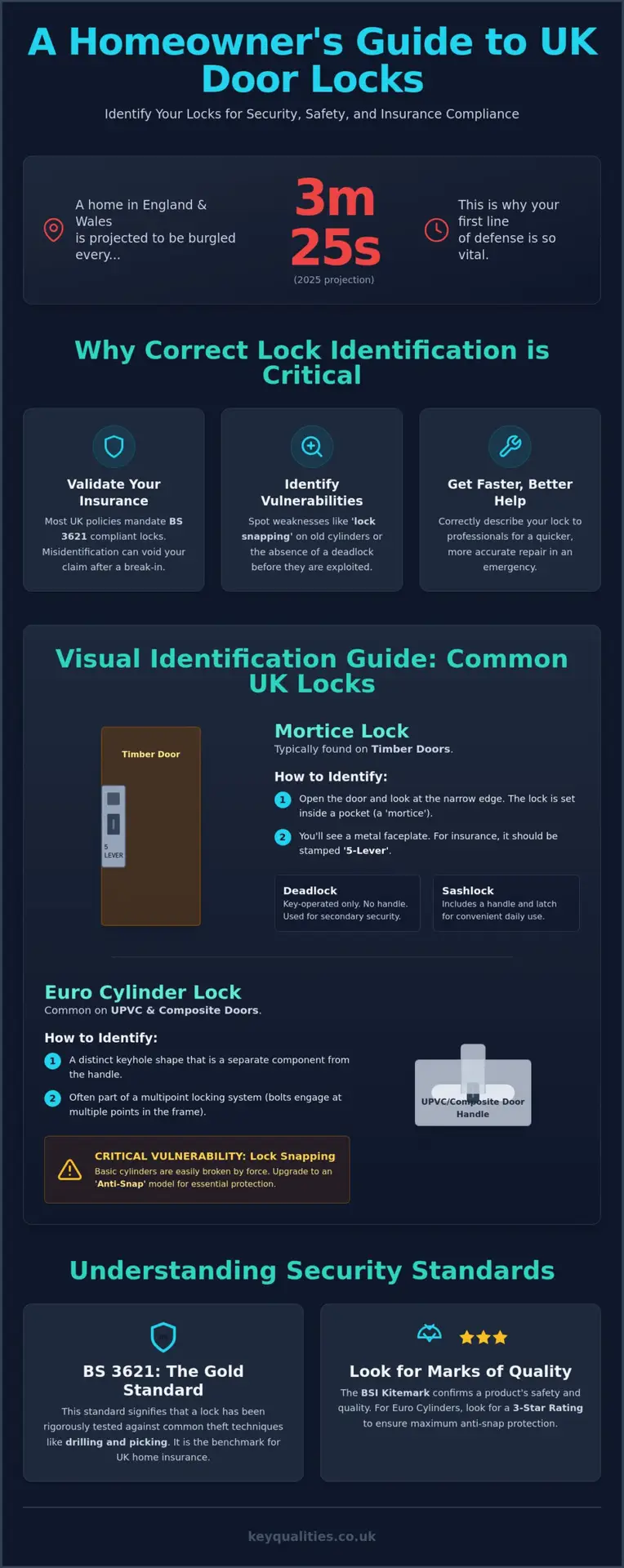
Did you know that in 2025, a home in England and Wales was burgled every 3 minutes and 25 seconds? It’s a sobering statistic that highlights why your home’s first line of defense is so vital. We understand the worry that comes when technical jargon like “mortice” or “euro cylinder” makes your own front door feel like a mystery. Identifying different types of door locks uk shouldn’t be a source of frustration, but a clear path toward reclaiming your peace of mind. We’re here to act as your dedicated advocate, ensuring your home remains a sanctuary of safety and dignity.
We believe that every person deserves to feel secure, which is why we’ve created this guide to help you accurately identify every external lock in your home. You’ll learn how to spot the BSI Kitemark on timber doors and recognize the essential star ratings on anti-snap cylinders for UPVC entries. We’ll also help you determine if your hardware needs a professional upgrade to the BS 3621:2017+A1:2024 standard or if a simple repair can restore your home’s integrity. Because professional security is about more than hardware; it’s about the lives we protect together.
Key Takeaways
- Ensure your home insurance remains valid by understanding the direct link between lock identification and policy compliance.
- Gain confidence in identifying different types of door locks uk, including the hallmark five-lever mortice deadlocks found on traditional timber doors.
- Learn to recognize the BSI Kitemark and the star-rating system to verify if your euro cylinders provide essential anti-snap protection.
- Empower yourself to spot failing multipoint mechanisms on UPVC doors before they compromise your home’s security.
- Discover how local security insights and professional assessments act as a bridge between mere placement and true home protection.
Why Correctly Identifying Your Door Locks Matters for Your Security
Your home represents more than just four walls; it’s where your most precious memories are held. When you take the time to understand the hardware protecting your front door, you’re taking an active role in safeguarding that environment. Identifying different types of door locks uk is a vital skill because it bridges the gap between feeling safe and actually being safe. Without this knowledge, you might unintentionally leave a door open to modern risks that older hardware simply wasn’t designed to handle. We believe that every homeowner deserves the dignity of a secure home, and that starts with knowing exactly what stands between your family and the outside world.
Being able to accurately describe your locks also transforms how we can support you during a crisis. If you’re facing a failing mechanism, providing clear details allows a professional to arrive fully prepared with the correct gearboxes or cylinders. This efficiency reduces your downtime and ensures the repair is right the first time. We believe that professional support should always prioritize your peace of mind, and that starts with a clear understanding of different types of door locks and their specific functions. This clarity is a fundamental part of a comprehensive home security assessment, where we work together to identify every potential point of entry and ensure your property is truly resilient.
Meeting UK Home Insurance Requirements
Insurers are incredibly specific about the level of protection they expect for your property. Most UK insurance providers mandate that all ground floor and accessible exits are fitted with locks that meet the British Standard BS3621. If you misidentify your locks on an application form and a break-in occurs, the insurer may refuse to pay out your claim because the security didn’t meet their stated criteria. BS3621 is the gold standard for UK residential security, indicating that a lock has been tested against common theft techniques like drilling and picking.
Identifying Vulnerabilities Before They Are Exploited
Many homeowners rely on older locks that are vulnerable to a technique known as “lock snapping,” which is particularly common with basic euro cylinders. By identifying your specific lock type, you can determine if you need an upgrade to an anti-snap model to protect against this prevalent method of forced entry. It’s also important to distinguish between a secure deadlock and a simple privacy latch, as the latter offers very little resistance to a determined intruder. Older timber doors often require a secondary security layer, such as a night latch paired with a mortice lock, to provide the structural integrity required to keep your home secure. Identifying different types of door locks uk allows you to spot these gaps before they become an invitation for trouble.
The Most Common UK Door Locks: A Visual Identification Guide
We understand that looking at your front door can sometimes feel like staring at a puzzle. Identifying different types of door locks uk is the first step in ensuring your home remains the safe haven your family deserves. When you can name the hardware protecting your entry points, you gain the power to make informed decisions about your safety. Most UK homes rely on a few specific mechanisms; knowing their visual cues helps you communicate effectively with professionals and insurers alike. We’re here to simplify the technical details so you can focus on what matters most: your peace of mind.
How to Identify a Mortice Lock
If you have a traditional timber door, you likely have a mortice lock. These are unique because they sit inside a “mortice,” which is a pocket cut directly into the door’s edge. To identify one, open your door and look at the metal faceplate on the edge. You’ll often see a stamp indicating the number of levers inside. For external security, a 5-lever mortice lock is the standard requirement for most insurance policies. You can distinguish between the two main types quite easily:
- Sashlock: This version features a latch and a handle, allowing you to open and close the door easily throughout the day.
- Deadlock: This version has no latch or handle and is operated only by a key, providing a sturdy secondary layer of security.
Identifying Euro Cylinder Locks
Modern UPVC and composite doors almost exclusively use Euro cylinder locks. You’ll recognize these by their distinct “oversized keyhole” shape, which looks like a circle sitting on top of an elongated triangle. These are barrel-style locks that pass through the door and connect with the internal mechanism. If you’re looking to replace one, measuring is critical. You must measure from the center screw hole to both the internal and external edges of the door. You might also spot Thumbturn variants, which have a knob on the inside. These are excellent for fire safety, as they allow you to exit quickly without searching for a key during an emergency.
Rim Latches and Nightlatches
Often called “Yale locks,” rim latches are surface-mounted on the inside of the door. They’re designed for quick access and convenience, latching automatically when the door is pulled shut. Most feature a “snib,” which is a small sliding button that allows you to temporarily deadlock the latch or hold it open. While they provide great day-to-day utility, we recommend they never serve as the only lock on an external door. They work best when paired with a sturdy mortice lock to provide the structural integrity required to keep your home truly resilient.
Always check the faceplate of any lock for the BSI Kitemark symbol. This mark is a promise of quality and compliance with British Standards, acting as a benchmark for your home’s security. If you’re struggling with identifying different types of door locks uk in your own home, don’t worry. If you’re unsure about your current setup, our team can help with British Standard Lock Upgrades to bring your home up to modern safety requirements. We’re here to act as your advocate, ensuring your hardware is as reliable as the community it protects.
UPVC and Composite Door Locks: Understanding Multipoint Systems
When you lift the handle on your front door, you’re engaging a complex symphony of security components designed to keep your family safe. Identifying different types of door locks uk becomes particularly important when dealing with these modern systems, as they rely on multiple locking points rather than a single bolt. Most UK households with UPVC or composite doors utilize a “lift-to-lock” mechanism. This action physically moves hooks, rollers, and deadbolts into the frame, creating a weather-tight and secure seal that a simple latch could never provide. We believe that understanding the mechanical “feel” of your door is the best way to safeguard your home’s integrity.
The heart of this entire operation is the UPVC door gearbox, which translates the movement of your handle into the synchronized deployment of the locking points. While UPVC doors often use a standard array of rollers and hooks, composite doors frequently feature more robust configurations to match their denser construction. These might include specialized “claws” or deeper-reaching bolts. Regardless of the door material, identifying different types of door locks uk requires you to look for these various engagement points along the vertical edge of the door when it is open. If these parts aren’t moving in perfect harmony, your security is compromised.
Identifying Multipoint Lock Failure Points
We often hear from homeowners who are frustrated by a “floppy handle” that no longer returns to its horizontal position. This is a classic symptom of a failed internal spring or a worn-out gearbox mechanism. If you find yourself struggling to turn the key even after lifting the handle, you’re likely dealing with an alignment issue where the hooks aren’t quite reaching their keeps. It’s a common misconception that a failing mechanism means you need to invest in a whole new door. In many cases, a professional can replace the central gearbox or adjust the hinges to restore full functionality, saving you both stress and unnecessary expense.
Patio and French Door Specifics
French doors and patio sliders introduce another layer of complexity with “master” and “slave” door sequences. The master door is the one you use daily, while the slave door typically features internal bolts at the top and bottom that must be secured first. You should also look for anti-lift blocks and security pins, which are small but vital components that prevent the doors from being forced out of their tracks. Multipoint locks are only as secure as the cylinder that drives them. Without a high-quality cylinder, even the most advanced multipoint system remains vulnerable to bypass techniques, which is why we always advocate for a holistic approach to your home’s protection.
British Standards and Anti-Snap: Is Your Lock Actually Secure?
Once you’ve finished identifying different types of door locks uk within your home, the next vital step is assessing their quality. A lock might look sturdy, but its true strength lies in the standards it was built to meet. We believe that every homeowner should have the tools to verify their own security, moving from uncertainty to a place of empowered protection. The most recognizable sign of a high-quality lock is the BSI Kitemark symbol. This heart-shaped logo isn’t just a decoration; it’s a benchmark of reliability that proves the hardware has undergone rigorous testing against forced entry. When we look at a lock, we don’t just see metal; we see the promise of a safe sanctuary for your loved ones.
In modern security, the “star” rating system for euro cylinders has become the primary language of safety. While a 1-star cylinder offers basic protection, it typically requires reinforced handles to be truly effective. For the highest level of security on UPVC or composite doors, we always look for the 3-star Kitemark. This indicates the cylinder can withstand advanced “lock snapping” techniques without the need for additional hardware. Investing in British Standard lock upgrades is often the most impactful way to safeguard Liverpool homes, ensuring your property remains resilient against evolving burglary methods.
Identifying BS3621 Compliance
For those with timber doors, the faceplate of your mortice lock should be your first port of call. You’re looking for the specific engraving: “BS3621.” This standard is what most UK insurers mandate because it ensures the lock is thief-resistant and can be operated by a key from both sides. It’s important to distinguish this from BS8621, which is a standard for locks that allow emergency egress without a key, often found in flats or apartments. If your insurance policy specifies BS3621 and you’ve identified a different standard, your coverage could be at risk during a claim. We’re here to help you navigate these complex requirements so your home stays both compliant and secure.
The Anti-Snap Checklist
Identifying different types of door locks uk also means looking for specific physical features that deter intruders. If you have a euro cylinder, check the front face for three small stars above the Kitemark logo. You can also look for “SS312 Diamond” ratings, which is the highest level of certification awarded by Sold Secure. High-security cylinders often feature “sacrificial cut lines.” These are visible grooves near the end of the cylinder designed to snap off during an attack, leaving the central locking mechanism intact and the door securely barred. Inside, these locks use hardened steel pins and reinforced central bridges to resist drilling and pulling. If your current locks lack these features, it’s time to consider a change.
Don’t leave your family’s safety to chance. If you’ve identified a vulnerability in your current setup, we can provide a professional Home Security Assessment to ensure every entry point meets the highest modern standards.
Securing Your Liverpool Home: Professional Lock Identification
While the technical process of identifying different types of door locks uk empowers you, applying that knowledge within the local context of Liverpool is where true safety begins. We know that the stakes remain high for our community, and a dedicated locksmith in Liverpool brings more than just a toolkit to your door; they bring an understanding of regional entry trends and the specific vulnerabilities of North West housing stock. We believe that professional identification acts as a bridge between mere placement and a deeply rooted sense of stability for your family.
At Key Qualities, we use our namesake as a benchmark for every interaction, ensuring that our technical competence is always matched by a human-centric approach. With over 40 years of experience, we’ve seen how the right hardware can transform a vulnerable property into a resilient home. Our mission is to provide professional support that leads directly to the improvement of lives within our shared community, moving beyond simple transactional placement toward long-term security partnerships.
The Key Qualities Approach to Home Protection
Our commitment to your well-being is reflected in our disciplined, non-destructive entry methods and our focus on high-standard operational repairs. We don’t just provide workers; we provide professionals who share our organization’s moral compass and dedication to social impact. By focusing on mechanical security rather than electronic alarms, we ensure your home has a permanent, physical defense that doesn’t rely on batteries or signal strength. This approach allows us to offer transparent, supportive service that prioritizes your dignity and empowerment.
Taking Action: From Identification to Installation
When you book a professional security audit with us, you can expect a thorough evaluation of every entry point. We move logically from identifying a need to offering a compassionate, high-quality solution. For many North West homes, we recommend upgrading to 3-star anti-snap cylinders as a matter of urgency to combat local forced entry methods. During an audit, we’ll check your alignment, verify your British Standard compliance, and ensure your multipoint systems are functioning with rhythmic precision. Getting in touch for an expert assessment is the first step toward a long-term commitment to your home’s safety.
Empowering Your Home Security Through Knowledge
Knowledge is the foundation of a secure home. We’ve seen how identifying different types of door locks uk allows you to spot vulnerabilities before they’re exploited and ensures your insurance policy remains a valid safety net. Whether you’re inspecting a traditional five-lever mortice or a modern multipoint system, your attention to detail is what keeps your sanctuary safe. We understand that the technical side of security can feel overwhelming, but you don’t have to navigate these requirements alone.
As a local Liverpool family-run business with over 40 years of construction and maintenance experience, we’re deeply committed to our community’s well-being. We specialize in high-security British Standard lock upgrades and provide the expertise needed to turn identification into action. Book your Liverpool home security assessment with Key Qualities today to ensure every lock on your door is a benchmark for quality and safety. We’re here to support you in building a more secure future for your family.
Frequently Asked Questions
How can I tell if my door lock is a 5-lever mortice deadlock?
Look at the metal faceplate on the edge of your door for a stamp that indicates the number of levers. A 5-lever mortice deadlock is recessed into the timber and doesn’t have a handle, requiring a long key with a “bit” at the end to operate. We recommend checking for the BS3621 engraving alongside the lever count to ensure your home meets essential insurance standards.
What is the difference between a Euro cylinder and a Rim cylinder?
You can distinguish them by their shape and how they’re mounted to your door. Euro cylinders feature a distinct “oversized keyhole” shape and pass through the door, while Rim cylinders are circular and connect to a nightlatch mounted on the internal surface. Identifying different types of door locks uk is much easier once you recognize these two common barrel styles used across modern and traditional homes.
Does my UPVC door have a multipoint locking system?
Open your door and look for several hooks, rollers, or bolts along the vertical edge that move when you lift the handle. If your door requires this “lift-to-lock” action before the key will turn, you have a multipoint system. These mechanisms provide a high level of security by engaging with the frame at multiple points, though they require a functional gearbox to operate safely.
How do I know if my locks meet British Standards for insurance?
Check the faceplate or the cylinder face for the BSI Kitemark symbol, which looks like a heart with an “S” inside. For timber door locks, you should also see the code “BS3621” engraved into the metal. On UPVC or composite doors, look for a 3-star rating above the Kitemark. These marks are benchmarks of quality that prove your hardware has been tested against modern burglary techniques.
What are the signs that my door lock gearbox is failing?
A failing gearbox often manifests as a “floppy” handle that no longer returns to its horizontal position after use. You might also notice that the mechanism feels gritty, makes clicking sounds, or requires significant force to engage the locking points. We believe in addressing these signs early to prevent a stressful lockout. Identifying these mechanical changes allows us to replace the internal mechanism before it fails completely.
Can I identify an anti-snap lock just by looking at it?
You can identify an anti-snap cylinder by looking for three small stars engraved above the BSI Kitemark on the front of the lock. When identifying different types of door locks uk, you might also spot “sacrificial cut” lines, which are visible grooves designed to snap off during a forced entry attempt. If your cylinder lacks these stars or lines, it may be vulnerable to common snapping techniques used by intruders.
Is it possible to have one key for all the different types of locks in my home?
Yes, it’s possible to have several locks “keyed alike” so they all operate with a single key. While this is straightforward for Euro cylinders on your front, back, and patio doors, matching them with traditional mortice locks is more complex. We can help you find a solution that balances the convenience of a single key with the high-standard security your property requires to stay resilient.
What should I do if I can’t identify the type of lock on my front door?
If you’re struggling to identify your hardware, the best approach is to take a clear photograph and seek professional guidance. We act as a dedicated advocate for your safety and can quickly help you understand your current setup via a simple consultation. It’s better to be certain than to guess when it comes to insurance compliance and the safety of your family. A professional assessment ensures your home remains a sanctuary.