
Did you know that 73% of burglars in the UK gain entry through a door, and a third of those incidents involve someone forcing the lock itself? If you live in the North West, keeping your home secure is a top priority, but standing in front of your entryway wondering “what type of lock do I have on my upvc door” can feel incredibly frustrating. You might be staring at a long metal strip and a keyhole, worried that ordering the wrong part online will leave your home vulnerable and your budget wasted.
We believe that every homeowner deserves the peace of mind that comes with a sturdy, reliable door. We are here to help you move past the confusion and gain the technical confidence needed to manage your home security. This guide will teach you how to accurately identify your UPVC door lock components, from the visible cylinder to the internal gearbox mechanism, so you can plan your next repair or upgrade with ease.
We will walk you through the simple steps to identify your lock brand, measure the PZ and backset dimensions correctly, and determine if you need a quick anti-snap cylinder swap or a full multipoint system repair.
Key Takeaways
- Understand your door’s two-part system to determine if you can upgrade your security by simply replacing the cylinder without disturbing the internal mechanism.
- Confidently answer “what type of lock do I have on my upvc door” by locating brand logos on the faceplate and identifying the teardrop shape of the Euro cylinder.
- Master the PZ measurement technique to ensure any replacement parts fit with precision, protecting you from the frustration of ordering incorrect hardware.
- Learn to distinguish between a jammed cylinder and a failed gearbox, helping you decide if you need a simple component swap or a professional repair.
- Identify the British Security standards, such as TS007, that offer the best protection for your home and provide lasting peace of mind for your family.
The Anatomy of a UPVC Door: Understanding the Two-Part System
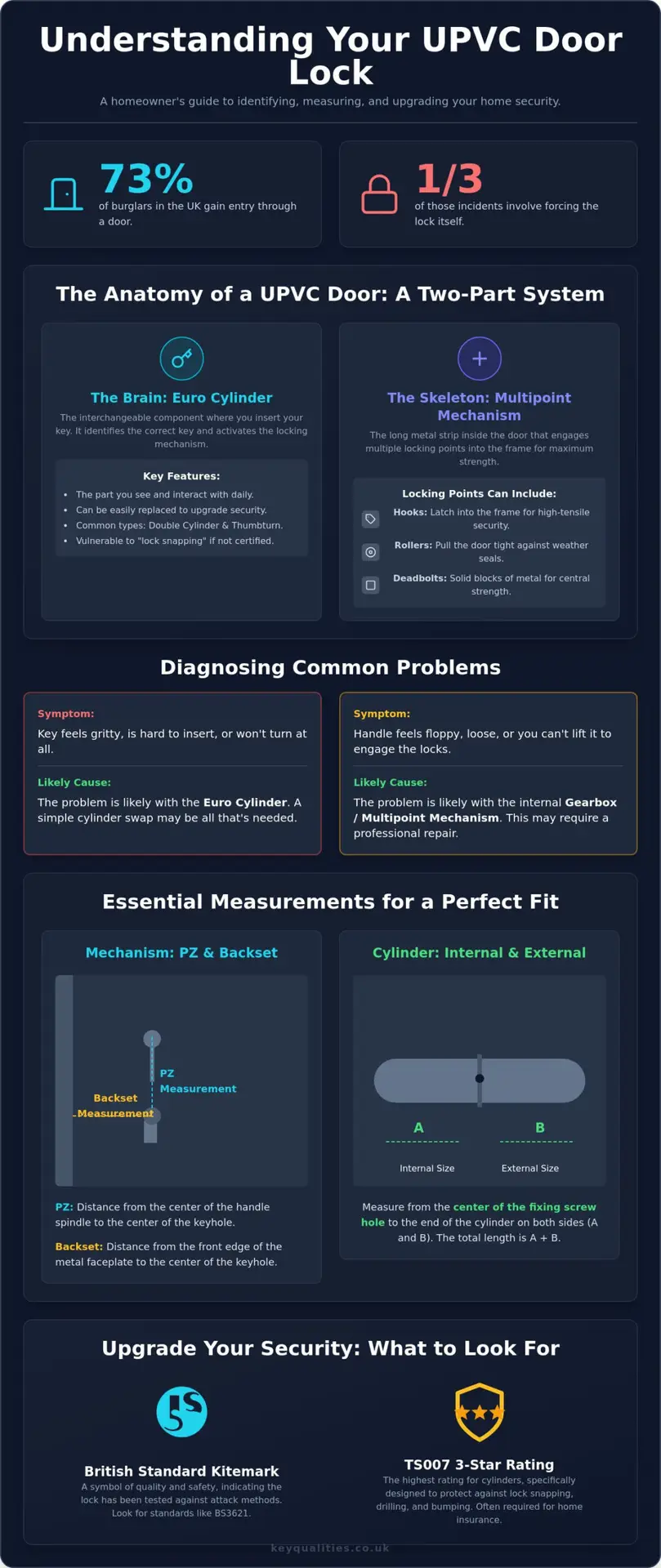
We understand the anxiety that comes with a faulty door lock. It isn’t just about hardware; it’s about the safety of your family and the sanctity of your home. When you find yourself standing in the hallway asking, “what type of lock do I have on my upvc door,” it helps to view the system as a partnership between two distinct components. Most modern UPVC doors don’t rely on a single, solid lock. Instead, they use a combination of a Euro Cylinder and a Multipoint Locking System working in harmony to keep your property secure.
Think of the Euro Cylinder as the “brain” of the operation. This is the part where you insert your key. It’s responsible for identifying the correct key and then triggering the rest of the system to move. Inside this component, a complex Pin Tumbler Lock Mechanism aligns to allow the lock to turn. A Euro Cylinder is the interchangeable heart of a UPVC door lock. This design is incredibly helpful for homeowners because it means you can often upgrade your security or change your keys by simply replacing the cylinder, without needing to touch the rest of the door’s internal hardware.
The Multipoint Locking System acts as the “skeleton” of your door. This is the long metal strip that runs the full height of the door’s edge. When you lift the handle, this mechanism drives several locking points into the door frame simultaneously. These points can include:
- Hooks: Curved metal pieces that latch into the frame for high-tensile security.
- Rollers: Small metal wheels that pull the door tight against the weather seal.
- Deadbolts: Solid blocks of metal that provide central strength.
Understanding this distinction is the first step toward regaining control over your home’s security.
Is your lock the Cylinder or the Mechanism?
Identifying the source of a problem is essential for a stress-free repair. If your key feels gritty or won’t turn at all, the issue usually lies within the cylinder itself. However, if the handle feels floppy or you can’t lift it to engage the hooks, the problem is likely within the gearbox of the multipoint mechanism. You can perform a simple visual check by opening the door. Look at the edge of the door to see the long metal strip of the mechanism, then look at the face of the handle to see the teardrop-shaped cylinder.
Why identification is the first step to security
Accurate identification protects you from the “wrong part” trap. Browsing hardware stores or online shops can be confusing, and ordering an incorrectly sized cylinder can leave your door vulnerable to lock snapping. When you can clearly answer “what type of lock do I have on my upvc door,” you empower yourself and your local locksmith. In the North West, providing these details allows a professional to give you an accurate quote over the phone and ensures the parts used meet UK home insurance compliance, such as the BS3621 or TS007 standards. We are committed to helping you find the right solution to keep your home a safe haven.
Identifying Your Euro Cylinder: The Part You See
Identifying the specific part that keeps your home safe starts with a simple look at the face of your lock. When you ask, “what type of lock do I have on my upvc door”, you are usually looking directly at the Euro cylinder. This component is easily recognisable by its distinct “teardrop” or “mushroom” shape. It is a universal design for UPVC doors across the UK, but the security features inside can vary significantly. Understanding these differences is one of the essential qualities of a proactive homeowner who values family safety.
You may have a “Double Cylinder”, which requires a key for both the inside and outside, or a “Thumbturn Cylinder”, which features a knob on the inside for easy exit. While thumbturns offer convenience during an emergency, double cylinders are often preferred for doors with adjacent glass panels. Regardless of the style, you must check for security ratings. Look for the British Standard Kitemark stamped on the face of the cylinder. High-quality locks often meet Approved Document Q security standards, which are the benchmark for security in new build homes and major renovations.
Measuring your cylinder is the next vital step. You cannot rely on a “standard” size because door thicknesses and handle depths vary. You need two measurements: the distance from the internal face to the centre of the fixing screw, and from the external face to the centre. These are expressed in millimetres, such as 35/35 or 40/45. If you feel unsure about these measurements, our team can provide a home security assessment to ensure your hardware fits perfectly.
The “Anti-Snap” Check: Does your lock protect you?
Lock snapping is a common technique used by intruders in the North West. To see if your home is protected, look for a 3-star logo or visible “snap lines” on the cylinder face. These lines are designed to break away during an attack, leaving the internal mechanism secure. Upgrading to these cylinders is a core part of a professional anti snap lock installation liverpool homeowners can rely on. A standard cylinder lacks these sacrificial points, making it a much easier target for forced entry.
Removing the cylinder for identification
Sometimes, the most accurate way to identify your lock is to see the whole part. Most Euro cylinders are held in place by a single long M5 screw located on the door edge, directly beneath the latch. By removing this screw and slightly turning the key, the cylinder should slide out easily. It is a simple process, but please never leave your door unattended or open while the cylinder is removed. Your home’s security is temporarily compromised during this window, so keep your tools ready and work efficiently to restore your peace of mind.
Identifying the Multipoint Mechanism: The Part Inside the Door
While the cylinder is the part you interact with daily, the multipoint mechanism is the silent guardian of your home’s perimeter. If you’re still wondering “what type of lock do I have on my upvc door”, it’s time to look at the long metal strip running down the vertical edge of your door. This is the “skeleton” of your security system. It dictates how your door physically connects to the frame at several different points, providing much more strength than a traditional single-point latch. We believe your home should be your sanctuary, and understanding this internal hardware is a vital step in protecting that space.
Finding the brand is your first mission in this detective work. Open your door and examine the metal faceplate. You’ll often find a logo or name stamped directly into the metal near the latch area. Common names to look for include Yale, GU, ERA, Avocet, or Fullex. If you can’t see a logo, don’t worry. Sometimes these stamps are hidden behind the handle backplate or have simply worn away over years of use. Identifying the brand helps us determine if you need a simple UPVC door gearbox replacement or a more extensive fix.
Next, take a moment to look at the locking points themselves. These are the parts that move when you lift the handle. You might see:
- Rollers: Small metal wheels that slide into a strike plate to pull the door tight.
- Hooks: Solid metal “claws” that grab into the frame for maximum pull-out resistance.
- Mushrooms: Pins with a wider head that slide into a slot, preventing the door from being pried open.
- Deadbolts: Square or rectangular blocks that provide central strength.
Knowing these shapes is essential for any multipoint locking system repair, as different brands use different combinations of these points.
Common UPVC Lock Brands in the UK
In our experience serving the North West, we often see Yale and ERA locks in newer developments. These brands are industry leaders for a reason and offer high levels of reliability. If you live in an older property, you might find GU Ferco or Avocet systems. These were the pioneers of multipoint security in the UK. Finding the brand stamp is a huge win because it allows us to source value-aligned professionals who share our commitment to quality when performing your repair.
Measuring like a pro
To be absolutely certain about your lock type, you need two critical measurements. The first is the PZ measurement. This is the distance from the centre of the handle spindle to the centre of the circular part of the keyhole. For most modern doors, 92mm is the “magic number”. If yours is different, you might have an older 70mm or 35mm system.
The second measurement is the backset. This is the distance from the very edge of the metal lock strip to the centre of the keyhole. Common sizes include 35mm or 45mm. Finally, check the width of the faceplate itself. Most are 16mm wide, but some heavy-duty doors use a 20mm strip. Having these numbers ready when you ask “what type of lock do I have on my upvc door” ensures that any replacement parts fit perfectly the first time.
Common UPVC Lock Problems: Why Identification Matters
Most homeowners only start asking “what type of lock do I have on my upvc door” when something goes wrong. We understand the sinking feeling you get when your front door won’t lock at night or your handle suddenly feels like it’s made of lead. Identifying your lock isn’t just a technical exercise; it’s the first step in solving a problem that affects your family’s safety and your daily routine. By knowing exactly what hardware you have, you can determine if you’re facing a simple alignment fix or a more serious mechanical failure.
The “Floppy Handle” syndrome is one of the most frequent issues we encounter. If your handle hangs down and no longer springs back to its horizontal position, the internal spring cassette or the gearbox itself has likely failed. This is a classic case where brand identification matters. A Yale mechanism requires a different internal component than an ERA or GU system. Similarly, if your key won’t turn, you need to know if the cylinder has jammed or if the gearbox cam has snapped. A quick test is to try the lock while the door is open. If it works perfectly then, your lock is fine, but your door has “dropped” and needs realigning.
Identifying a gearbox failure versus a full strip replacement is the difference between a quick repair and a major overhaul. If the rest of the metal strip is in good condition, replacing the central gearbox is often the most efficient path forward. We believe in providing solutions that empower you, rather than just selling you parts you don’t need. Understanding your lock type ensures you get the right fix at the right time.
UPVC Gearbox Replacement vs. Full Strip
Many people assume that a broken lock means they have to replace the entire long metal strip. This can be an expensive mistake. In many cases, we can perform a UPVC door gearbox replacement, which involves only changing the central “engine” of the lock. This approach is much more cost-effective and creates less waste. To do this successfully, you must identify if your current gearbox is compatible with modern replacement parts, as older, discontinued models might require a full system upgrade to maintain security.
When to call a Liverpool Locksmith
If you notice grinding noises or find that you have to “force” the handle up to lock the door, please stop. Forcing a stiff mechanism is the fastest way to cause a total failure, which often leads to an expensive emergency lockout. We recommend acting early. A professional home security assessment can catch these issues before they leave you stranded outside. We are dedicated to providing reliable solutions that restore both your door’s function and your peace of mind.
If your door is showing signs of wear or you are struggling to identify your mechanism, we are here to help. Contact us today for professional UPVC door lock assistance and let our team secure your home with the expertise it deserves.
Upgrading Your Security: From Identification to Installation
Once you have answered the question, “what type of lock do I have on my upvc door,” you have the power to transform your home’s security from a source of worry into a pillar of strength. Identification is the essential foundation, but the true value lies in the upgrade. We believe that every family in the North West deserves the highest level of protection, moving beyond basic hardware to solutions that offer genuine peace of mind. We are here to guide you through that transition with professional authority and heartfelt care.
When choosing your new components, look for the TS007:2024 + A1:2026 technical specification. This standard uses a star rating system where a 3-star rating represents the pinnacle of security for a Euro cylinder. You can achieve this through a 3-star cylinder alone or by pairing a 1-star cylinder with 2-star security hardware like a reinforced handle. For those seeking the ultimate benchmark, the SS312 Diamond approved standard offers even more rigorous testing against professional attack methods. These aren’t just technical labels; they are promises of reliability that protect your most valuable assets and the people you love.
Before you commit to a purchase or installation, run through your final identification checklist:
- Brand: Confirm the brand matches your existing handle and door thickness.
- PZ Measurement: Ensure the distance from the spindle to the keyhole is correct.
- Backset: Double-check the depth from the door edge to the cylinder.
- Security Rating: Verify the presence of the Kitemark or Sold Secure Diamond logo.
British Standard Upgrades
A professional British Standard lock upgrade is about more than just the internal mechanism. High-security reinforced handles provide a physical barrier that complements your anti-snap cylinder. In our community, anti-snap technology is no longer an optional luxury; it’s a necessity. These locks are designed to remain secure even if the external part of the cylinder is broken off, ensuring that your home remains a sanctuary against forced entry.
Professional Support from Key Qualities
We act as a bridge between your current security concerns and the safety your family deserves. Our team represents the key qualities of reliability and technical excellence, linking our professional support to the lasting safety and improvement of your daily life. If you are still struggling to identify your lock, we can help. You can send us a quick photo of your door edge and handles, and we will use our expertise to identify the parts for you.
We are committed to non-destructive entry and high-standard repairs that respect the integrity of your home. Whether you need an urgent repair or want to book a free home security assessment, we are here to act as your dedicated advocate. We don’t just provide hardware; we provide professionals who share your values and understand the high stakes of home security. Let us help you secure your future today.
Securing Your Home with Confidence
Taking the time to identify your door hardware is a powerful act of care for your household. You now understand that your security relies on both the “brain” of the Euro cylinder and the “skeleton” of the multipoint mechanism. By mastering measurements like the PZ and backset, you have moved past the confusion of asking “what type of lock do I have on my upvc door” and toward a proactive plan for your home. Choosing high-security upgrades like anti-snap cylinders is a practical step toward lasting peace of mind for your family.
If you feel unsure about the technical details or need a professional touch to restore your door’s function, we are here to act as your dedicated advocate. With over 40 years of construction and maintenance experience, our team specializes in intricate UPVC gearbox and mechanism repairs. We are a local Liverpool business focused on empowering our community through high-standard security improvements. Contact Key Qualities today for expert Liverpool locksmith services to ensure your home remains a safe haven. We look forward to helping you protect what matters most.
Frequently Asked Questions
How do I know if my UPVC door lock is a 92mm PZ?
Measure the distance from the centre of the handle spindle to the centre of the circular part of the keyhole. If this measurement is 92mm, you have the most common standard for modern UK doors. This measurement ensures that your handles and lock mechanism align perfectly for smooth operation. We find that getting this measurement right is the first step in a successful repair and a secure home.
Can I replace just the handle on my UPVC door?
Yes, you can replace the handle independently as long as the PZ measurement and the distance between the screw holes match your door perfectly. It’s a great way to refresh your home’s appearance without touching the internal mechanism. However, if the handle is floppy because of a broken spring inside the door, a new handle won’t fix the underlying gearbox issue. We recommend checking the internal mechanism first to save you time and money.
What brand is my UPVC door lock if there is no name on it?
You can identify an unbranded lock by measuring the PZ, the backset, and the width of the metal faceplate. Many older mechanisms lack visible logos, so we look at the shape of the hooks or rollers to determine the manufacturer. If you are struggling with “what type of lock do I have on my upvc door,” a quick photo of the gearbox area helps us identify it for you. We believe in providing the technical clarity you need to protect your sanctuary.
Is a Euro cylinder the same as a multipoint lock?
No, they are two separate parts of a shared security system. The Euro cylinder is the “brain” where you insert your key, while the multipoint lock is the “skeleton” strip that runs down the edge of the door. We often replace just the cylinder to upgrade security without needing to remove the entire long metal mechanism. This distinction allows for more cost-effective maintenance while keeping your standards high.
How do I measure the backset on a UPVC door lock?
Measure the distance from the flat front edge of the metal lock strip to the centre of the keyhole. This is typically 35mm or 45mm on most residential doors in the North West. Accurate backset measurements are vital because even a few millimetres of difference will prevent a replacement gearbox from fitting into the pre-cut slot in your door. We are here to help you get these details right so your repair is seamless.
What is the difference between a split spindle and a single spindle lock?
A single spindle lock allows the handle to operate the latch from both sides at all times. A split spindle system requires a key to open the door from the outside, even if the door isn’t fully locked. This provides an extra layer of security for your family by preventing someone from simply walking in if you’ve forgotten to turn the bolt. It’s a small mechanical difference that offers significant peace of mind.
Does my home insurance require a specific type of UPVC lock?
Most UK insurers require your external doors to be fitted with a lock that meets British Standard BS3621 or has a 3-star TS007 rating. We recommend checking your policy details carefully to ensure your coverage remains valid. High-security hardware is about more than just compliance; it’s about making sure your home is a truly safe environment for your loved ones. We are dedicated to helping you meet these essential standards.
How can I tell if my UPVC door lock is anti-snap?
Look for the British Standard Kitemark and a 3-star rating stamped directly onto the face of the cylinder. You might also see visible “snap lines” near the ends of the lock body. These features are designed to sacrifice the outer part of the lock during an attack while keeping the internal mechanism secure. If your lock face is plain, it likely lacks this essential protection. Upgrading these locks is a key part of our mission to empower homeowners.