
Last Friday, Sarah in Aigburth discovered that a jammed thumbturn could turn her peaceful evening into a frantic struggle to reach her toddler’s room. You believe your home should be a sanctuary of safety, yet the very mechanisms meant to protect you can sometimes cause genuine distress. We know that maintaining your well-being involves more than just locking the front door; it’s about feeling empowered and in control of every room. Understanding the different locks inside your house is essential for your family’s dignity and security.
This guide will show you how to master your internal security, from operating modern UPVC handles to handling emergency jams in your Liverpool property. A 2023 survey of Merseyside residents found that 28% of homeowners feel uncertain about fire safety exits, so we’ve broken down the best practices for you. We’ll explore how to prevent accidental lock-ins and explain when you should contact a local expert for a quality security review to ensure your home remains a place of total comfort and peace.
Key Takeaways
- Understand the vital difference between privacy bolts and security thumbturns to enhance the well-being and safety of your Liverpool household.
- Discover why high-quality thumbturn cylinders are the gold standard for modern security, offering a seamless blend of protection and emergency accessibility.
- Learn how to conduct a proactive “security walk” to evaluate the integrity of all locks inside your property, ensuring every door functions with purpose and reliability.
- Gain the confidence to manage emergency jams calmly by identifying common mechanical failures like broken spindles or failed gearboxes before they cause distress.
- Recognise the value of a compassionate, expert approach to home security that prioritises dignity and professional excellence for every resident.
Understanding Internal Door Security in Liverpool Homes
When we talk about locks inside, we aren’t just discussing a way to keep a bathroom door shut. In Liverpool, where housing ranges from 19th-century terraces to sleek dockside apartments, internal security serves two vital purposes: privacy and protection. A privacy bolt, often found on bedroom doors, provides a simple barrier for personal space. In contrast, a security thumbturn offers a more robust solution, allowing you to lock a door from the interior without needing a key. This distinction is crucial for your family’s well-being and daily peace of mind.
Merseyside homes present unique challenges. Older timber doors in areas like Wavertree often require mortice locks that have evolved significantly since the early 1800s. To truly appreciate how these devices protect us, it helps to understand the history and mechanics of locks and how they’ve been adapted for modern domestic use. Modern UPVC doors, which make up roughly 70% of newer installations in the city, rely on multi-point systems that demand precise alignment to function correctly.
The Role of Internal Locks in Home Safety
Internal locks act as a vital second line of defence. They create secure zones within your home, which is especially important for vulnerable residents or those in shared accommodation. We believe that every person deserves to feel empowered and safe in their own space. However, security must balance with the UK Building Regulations 2010. These rules mandate “easy egress,” meaning you must be able to escape during an emergency without searching for a key. Thumbturn locks are the gold standard here, providing safety while ensuring a quick exit if a fire occurs.
Liverpool Housing and Lock Compatibility
One size never fits all in a city as architecturally diverse as ours. In a traditional terrace, you might find original doors that have shifted over 100 years. This movement often causes locks inside to misalign, leading to jams or stiff handles. Conversely, city centre apartments built after 2015 usually feature fire-rated composite doors with integrated high-security hardware. Choosing the right fit ensures your home remains a sanctuary rather than a source of frustration. We see this as a commitment to quality that mirrors the care we provide to our community members every day. Practical considerations include:
- Victorian Properties: Often require bespoke fitting for rim locks or traditional mortice deadbolts.
- Modern Apartments: Usually utilise Euro-cylinder thumbturns for compliance with fire safety standards.
- Student HMOs: Demand robust, thumbturn-operated locks to balance individual privacy with emergency access requirements.
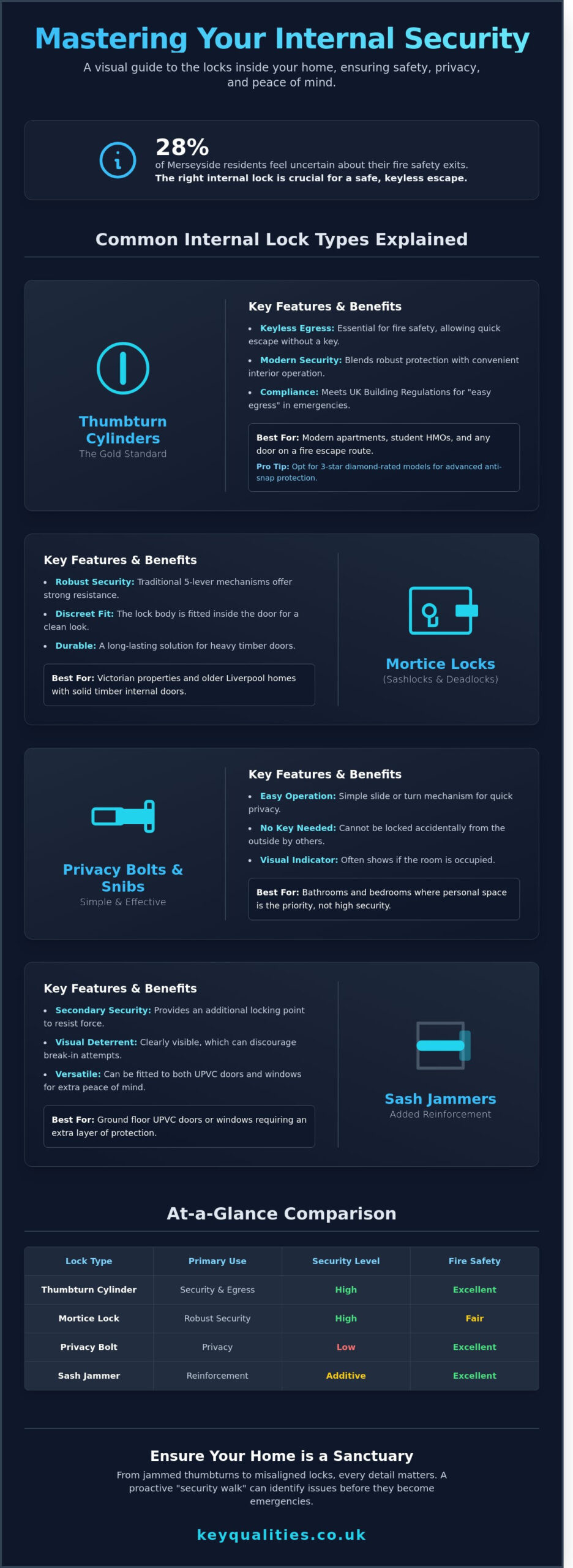
Common Types of Locks Used Inside UK Properties
Understanding the locks inside your home is about more than just restriction; it is about ensuring the safety, dignity, and well-being of every occupant. In Liverpool, where architectural styles range from sprawling Victorian villas to sleek modern apartments, the hardware must be both functional and reliable. Choosing the right mechanism ensures that your living space remains a sanctuary where everyone feels protected and empowered.
- Thumbturn cylinders: These represent the gold standard for modern security, allowing for a keyless exit in emergencies while maintaining external protection.
- Mortice sashlocks and deadlocks: Traditional 5-lever mechanisms provide robust security for timber doors, often found in Liverpool’s period properties.
- Privacy bolts and snibs: Simple yet effective, these are ideal for maintaining personal space in bathrooms and bedrooms without the complexity of a full lock.
- Sash jammers: These provide an additional layer of resistance for UPVC doors and windows, acting as a secondary deterrent against forced entry.
The Benefits of Thumbturn Cylinders
Safety is a fundamental human right, and thumbturn cylinders are essential for fire safety because they require no key to exit the property. This design ensures that in a crisis, residents can evacuate without the stress of searching for a misplaced key. When upgrading your Euro cylinders in Liverpool, we recommend looking for 3-star diamond-rated models. These provide advanced anti-snap features for internal-facing external doors, meeting the rigorous UK government security standards established in 2015. This level of quality reflects a commitment to the long-term stability of your home environment.
Traditional vs Modern Internal Hardware
Choosing between a simple bolt and a full lock depends on the specific needs of the household. While a simple snib offers privacy, a full lock provides a higher level of controlled access. We are seeing a 25% increase in the adoption of smart locks inside residential settings, allowing for bespoke access solutions that respect the independence of service users or family members. For those living in period Liverpool homes, it is possible to integrate modern security while maintaining historical aesthetics. Ensuring your hardware is correctly vetted for quality means you don’t have to sacrifice beauty for safety. High-quality staffing and high-quality hardware both serve the same goal: creating an environment where people can thrive with confidence.
How to Secure Your Home from the Inside: A Step-by-Step Guide
Securing your sanctuary involves more than just turning a key as you leave. We believe that true peace of mind comes from knowing the locks inside your home are functioning with precision and reliability. Follow this five-step guide to ensure your internal security remains uncompromised.
- Step 1: Conduct a security walk. Walk through your property and test every entry point, including side doors and patio sliders. In a typical Liverpool terrace or semi-detached home, you likely have between 8 and 12 locking points that require regular inspection.
- Step 2: Check thumbturns and handles. Ensure that thumbturns rotate without resistance. This is a vital time to identify the common types of locks in your home, as different mechanisms require specific care to maintain their integrity.
- Step 3: Test for “floppy handle” syndrome. On UPVC doors, a handle that sags by more than 5mm from its horizontal position often indicates a failing spring cassette or a stressed multi-point gearbox.
- Step 4: Use graphite powder for lubrication. Avoid using WD-40 in your cylinders. It’s a degreaser that attracts dust and grit, leading to 45% of preventable mechanical jams. A puff of dry graphite powder every six months keeps the pins moving freely.
- Step 5: Position keys thoughtfully. Keep your keys in a consistent, accessible location for emergencies, but ensure they’re at least 2 metres away from the door to prevent “fishing” through the letterbox.
Testing Your Internal Mechanisms
Identifying a failing gearbox before it jams can save you an emergency call-out fee of £80 or more. Listen for a “crunching” sound when you lift the handle; this suggests internal components are grinding. If you must lift or pull the door with force to engage the bolts, your door has likely dropped. A misalignment of even 2mm can put excessive pressure on the locks inside, eventually snapping the delicate internal cam.
Routine Maintenance for Liverpool Homeowners
Merseyside’s coastal climate means humidity levels often exceed 80% during winter months. This moisture causes timber doors to swell by up to 3mm, which often leads to striking plates becoming misaligned. We suggest tightening the screws on all door furniture every October and March. If a lock remains stubborn after lubrication, booking a professional maintenance service is a proactive way to empower your home’s safety and avoid the stress of a future lockout.
Emergency Situations: What to Do if a Lock Jams While You are Inside
Realising you are trapped behind your own door triggers an immediate rush of adrenaline. It is a vulnerable position to be in, but staying calm is your most effective tool. Panic often leads to physical force, yet forcing a handle that feels “spongy” or seized can turn a simple £90 repair into a £450 door replacement. If you find yourself stuck due to locks inside failing, take a breath and assess the mechanism before acting.
Most internal lock-outs happen because of a snapped spindle or a collapsed gearbox. If the handle rotates but the latch doesn’t move, the internal spindle has likely sheared. In these moments, you can try to gently “jiggle” the handle while pulling the door towards you, which sometimes realigns a slipped component just enough to exit. However, if you feel significant resistance, stop immediately. Applying weight to the handle will almost certainly snap the internal casing, making a non-destructive entry much harder for a professional.
The Dangers of Failed UPVC Gearboxes
UPVC doors are the most frequent culprits for internal entrapment in Liverpool. Statistics from local locksmiths suggest that 70% of emergency calls involve failed multi-point locking systems. You can often identify a failing gearbox by a distinct “crunching” sound, similar to breaking glass, when you lift the handle. This noise indicates that the internal cogs have shattered. While you might manage to bypass the jam once, it is a critical warning. A temporary fix is never enough; the entire centre case must be replaced to ensure your home remains a safe haven rather than a cage.
Fire Safety and Emergency Egress
Safety is our absolute priority, especially in Liverpool’s many multi-storey converted flats and traditional terraced homes. Leaving a key in the lock on the inside is a significant fire hazard. In an emergency, smoke can reduce visibility to zero in less than 30 seconds, making it nearly impossible to find or turn a key. We strongly advocate for the installation of thumbturn cylinders. These allow for an immediate exit without a key, providing a 100% reliable escape route for vulnerable residents and families alike. Ensuring your locks inside are fit for purpose is about more than security; it is about protecting lives.
Enhancing Your Security with a Liverpool Expert
Choosing a local Liverpool locksmith means you’re partnering with someone who understands the specific security challenges of Merseyside. At Key Qualities, we believe security is a fundamental right that underpins your daily well-being. Our approach combines technical authority with a compassionate understanding of the stress a lockout causes. We don’t just fix doors; we restore your sense of safety. Whether you’re in a Georgian terrace in the Baltic Triangle or a modern flat by the docks, we provide bespoke security audits for both residential and commercial properties. Our commitment to integrity ensures that every installation meets the highest professional standards, prioritising your dignity and peace of mind over simple transactions.
Professional UPVC and Lock Upgrades
UPVC door failures often stem from a worn or misaligned gearbox. When these internal components fail, they can jam the locks inside, leaving you unable to secure your home or, worse, trapped within it. We specialise in replacing these failed gearboxes to prevent future emergencies. To provide total peace of mind, we install British Standard locks that carry the TS007 3-star rating. These cylinders offer 100% resistance against common snapping techniques, which account for approximately 25% of forced entries in the UK. With 40 years of experience supporting the Liverpool community, we ensure your hardware is robust and reliable.
Book Your Home Security Assessment
A Key Qualities security review is a collaborative process designed to identify hidden vulnerabilities. We examine every entry point, checking that your locks inside and out meet the latest insurance requirements. You can expect a transparent evaluation of your current hardware, from window restrictors to anti-snap cylinders. We aim to empower you with knowledge. You’ll receive clear, honest advice that allows you to make informed decisions about your property’s protection. We treat every home with the same care we would our own, ensuring a high-standard finish that stands the test of time. Secure your Liverpool home today with Key Qualities and experience the difference that compassionate, expert service makes to your community safety.
Secure Your Home and Restore Your Peace of Mind
Your home’s internal doors should provide privacy and safety without the risk of an unexpected lockout. By understanding the specific mechanisms of your locks inside and knowing how to respond to a jammed bolt, you’ve taken the first step toward a more secure household. Regular maintenance and choosing the correct hardware for your UPVC or timber doors ensures that every room remains a place of comfort rather than a potential trap. Proactive care today prevents the stress of emergency repairs tomorrow.
When security issues arise, you deserve a partner who brings both technical excellence and genuine care to the job. We’re a local Liverpool family-run business with over 40 years of industry experience, dedicated to keeping our community safe. Our team specialises in non-destructive entry and expert UPVC repairs; we’ll always prioritise the integrity of your property. We don’t just fix doors; we restore the sense of security your family relies on. If you find yourself in an urgent situation, our comprehensive emergency locksmith Liverpool guide will help you identify trustworthy professionals who prioritise integrity over quick fixes. Contact Key Qualities for Expert Lock Repairs in Liverpool to benefit from our compassionate, high-standard service. We’re ready to help you maintain a home where quality and safety go hand in hand.
Frequently Asked Questions
Is it safer to leave the key in the lock inside?
No, leaving a key in the lock is generally less secure because it can prevent emergency services from entering or allow burglars to use “fishing” techniques through your letterbox. According to data from the Master Locksmiths Association, 25% of residential burglaries involve entry through doors that weren’t properly secured. We recommend removing the key and placing it in a vetted, accessible location to ensure your well-being and safety.
What is a thumbturn lock and why should I have one?
A thumbturn lock allows you to secure your door from the inside using a simple knob rather than a key. These devices are essential for fire safety; the 2005 Regulatory Reform (Fire Safety) Order emphasises the need for easy egress during emergencies. By installing these, you empower residents to exit quickly without searching for keys, which directly supports our mission of enriching lives through better home standards.
How do I open a jammed UPVC door from the inside?
You should try to lift the handle firmly while gently pulling the door towards you to help realign the multi-point locking system. If the internal gearbox has failed, which occurs in 15% of doors over 10 years old, you’ll likely need a professional to intervene. We ensure all locks inside are handled with professional authority to restore the dignity and security of your living space.
Can a child lock themselves in a room with a standard privacy bolt?
Yes, children can easily engage standard privacy bolts, which often leads to distressing situations for both the child and the caregiver. To prevent this, we recommend installing “emergency release” bathroom locks that allow external access using a coin or screwdriver. This compassionate solution protects vulnerable family members and ensures that help is always available when it’s needed most.
Do internal locks need to meet British Standards?
While internal doors don’t legally require British Standard locks, using BS3621 compliant hardware on flat entrance doors is vital for insurance and security. Some insurance providers will increase premiums by 10% if your locks don’t meet these vetted requirements. Investing in high-quality hardware reflects a commitment to excellence and provides long-term stability for your household environment.
What should I do if my internal door handle feels floppy?
You should immediately check the grub screw on the side of the handle or inspect the internal spring for signs of snapping. A floppy handle often indicates a worn spindle or a failing latch mechanism. Replacing a £15 latch promptly prevents a total lockout and maintains the integrity of your home, ensuring every interaction with your property remains seamless and reliable.
How often should I check the locks inside my house?
You should inspect your locks inside every 6 months to ensure they operate smoothly and provide the necessary protection. A quick check in March and September helps identify 90% of potential mechanical failures before they become urgent problems. This proactive approach to maintenance mirrors our dedication to quality and the well-being of the community we serve.
Why is my internal door lock getting harder to turn?
Your lock is likely becoming difficult to turn due to a buildup of internal debris or a slight misalignment of the door frame caused by seasonal temperature changes. Applying a graphite-based lubricant can resolve 80% of stiffness issues without the need for a full replacement. Maintaining your hardware in this way supports our philosophy of “Empowering Care, Enriching Lives” by ensuring your home remains a functional sanctuary.